
होमKabaddiKabaddi Champions League: 10 Teams and a Rs 5 Crore Purse, But the Real Story Is Buried in PKL's Broadcast Crisis
Kabaddi Champions League: 10 Teams and a Rs 5 Crore Purse, But the Real Story Is Buried in PKL's Broadcast Crisis
कबड्डी चैंपियंस लीग का दूसरा सीज़न 8 से बढ़कर 10 टीमों का हो गया है और हर फ्रैंचाइज़ी को 5 करोड़ रुपये (करीब 6 लाख डॉलर) का नीलामी पर्स दिया गया है। सभी 10 फ्रैंचाइज़ी हरियाणा के शहरों की हैं — भिवानी, रोहतक, करनाल, गुरुग्राम, सोनीपत, पानीपत, फरीदाबाद, हिसार, झज्जर और कुरुक्षेत्र — इसलिए यह प्रभावी रूप से एक प्रादेशिक, अर्ध-पेशेवर लीग है, राष्ट्रीय नहीं। नीलामी में सबसे ऊंची बोली आयन लोचब पर 17.4 लाख रुपये लगी, जबकि 'भारत के एशियाई खेल कप्तान' बताए गए सुनील मलिक 10 लाख रुपये में बिके — पीकेएल में शीर्ष रेडरों की कीमत 1 करोड़ रुपये से ऊपर रहती है, यानी यहां का शीर्ष दाम उसका लगभग छठा हिस्सा है। ट्रायल्स में करीब 6,400 पंजीकरण हुए और 300 से अधिक खिलाड़ी नीलामी पूल में पहुंचे; यह आंकड़ा मांग का नहीं, ग्रामीण खिलाड़ियों के अवसर की आपूर्ति का संकेत है। सबसे महत्वपूर्ण संदर्भ यह है कि प्रो कबड्डी लीग का 13वां सीज़न कथित तौर पर जून-जुलाई 2027 तक खिसक गया है क्योंकि उसका ब्रॉडकास्ट साझेदार नहीं है और नया साझेदार तय नहीं हुआ। रिपोर्ट में लीग की ब्रॉडकास्ट डील, स्पॉन्सरशिप, दर्शक संख्या या राजस्व का कोई ज़िक्र नहीं है, और एकेएफआई/आईकेएफ मान्यता, खिलाड़ी अनुबंध तथा एंटी-डोपिंग नियमों पर भी कोई जानकारी नहीं दी गई है। इसलिए 10 टीमों का विस्तार अभी एक घोषणा है, सिद्ध उपलब्धि नहीं; असली संकेतक पीकेएल का नया मीडिया अधिकार सौदा, लीग की मान्यता स्थिति और उसका प्रसारण समझौता होगा।
The Kabaddi Champions League is expanding from 8 to 10 teams in its second season, with each franchise allotted an auction purse of Rs 5 crore. On the surface this reads as a strong signal for any emerging league — more teams, more spending on players, and a big claim about drawing talent from the grassroots. But the same report carries a piece of information that changes the entire context: the Pro Kabaddi League's (PKL) 13th season has reportedly been pushed to June-July 2027, because it no longer has a broadcast partner and a replacement has not been finalised. In other words, at the very moment kabaddi's biggest stage is stalled, a regional league is announcing expansion. That could be coincidence, or it could be opportunism.
The first question concerns the definition of the number. It is not clear whether the Rs 5 crore purse is per franchise or for the entire league. The phrasing used in the report — 'greater scope to assemble their squads' — suggests it is a per-team budget, but there is no official confirmation. The second question concerns the amount itself. Rs 5 crore is roughly US$600,000. A single PKL franchise's typical auction outlay has historically been several multiples of that. In budget terms, therefore, this league is not a PKL competitor but sits a tier below — a developmental or semi-professional tier. It is also worth noting that an 'auction purse' is not prize money; it is the total squad-building budget, a distinction that is frequently misread as a measure of a league's financial strength.
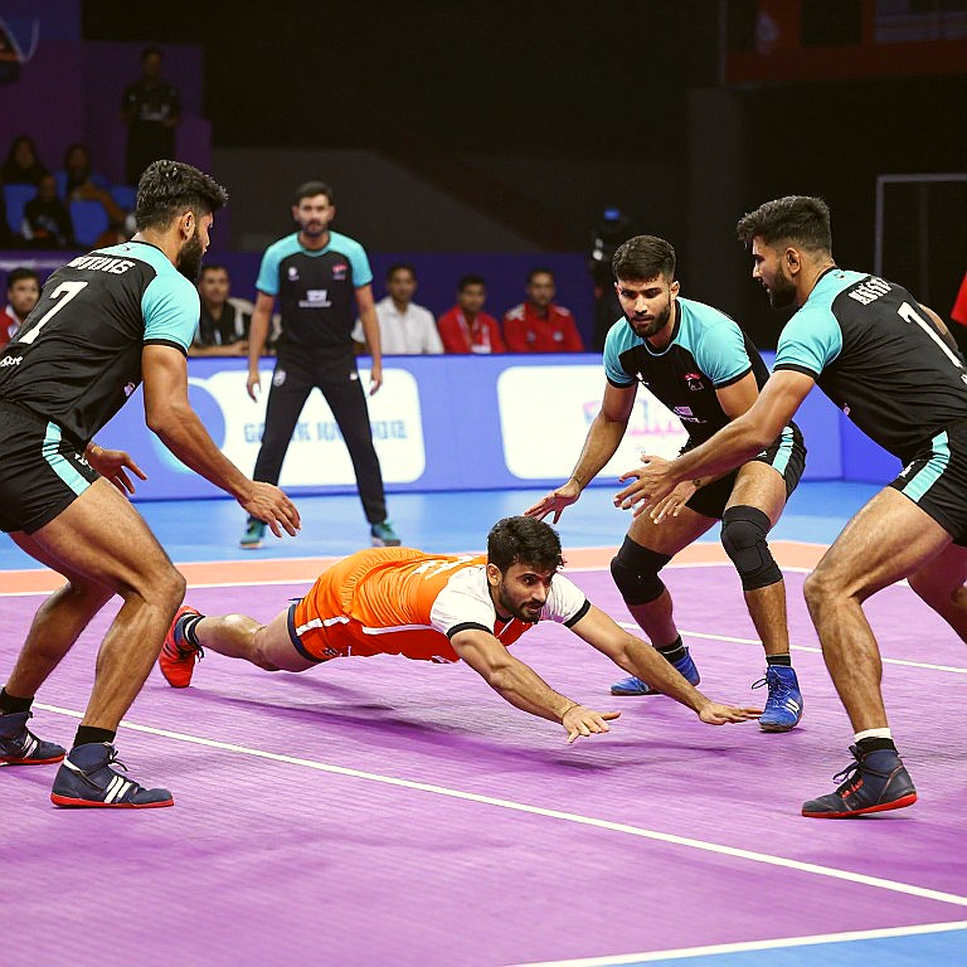
For readers unfamiliar with the sport: kabaddi is a 7-vs-7 contact game in which a 'raider' crosses into the opponent's half, must continuously chant 'kabaddi' to prove he is not inhaling, and scores by touching defenders and escaping back safely. A raid lasts 30 seconds. The PKL launched in 2026 and became the sport's commercial anchor. An auction is the mechanism by which franchises bid for players from a pool, with each player carrying a base price. This report contains no on-field rule information at all — no mention of Standard or Circle Style, no foreign-player quota, no squad size. This is a story about format and business, not about rules.
The auction results reinforce the picture above. The highest bid was Rs 17.4 lakh for Ayan Lochab. On the other side, Sunil Malik — described as 'India's Asian Games captain' — went for Rs 10 lakh. The tournament's most expensive player is worth Rs 17.4 lakh, while a claimed national-team captain is worth Rs 10 lakh. That gap is telling in itself. In the PKL, top raiders have commanded Rs 1 crore and above — meaning this league's ceiling is roughly one-sixth of that. The 'Asian Games captain' label should also be read with caution: the designation may be dated, may relate to a different edition or to Circle Style, or may simply be a reporting error. No independent confirmation is available in the information provided.
The grassroots picture, by contrast, is large. Around 6,400 registrations were recorded for the trials, of which more than 300 players made it into the auction pool. Haryana's kabaddi and wrestling tradition flows from village akhadas, from which hundreds of players try to reach the professional level every year. By that measure, 6,400 is genuinely a big number. But it should not be read as the league's popularity. It is a supply-side number, not demand-side — a reflection of rural young people's hunger for sporting opportunity in a place where options are limited. A league's commercial health is measured by attendance, ticket sales, TV ratings and sponsorship, and this report contains no data on any of them.
The league's geographic footprint is also not as large as its name. All ten franchise cities — Bhiwani, Rohtak, Karnal, Gurugram, Sonipat, Panipat, Faridabad, Hisar, Jhajjar and Kurukshetra — are in Haryana. The name 'Champions League' can create the impression of national or international significance, but in practical terms this is a regional competition. There is no recorded presence in Maharashtra, Punjab or South India. Haryana is called India's sports nursery, and its contribution to kabaddi has been disproportionately large, so choosing it as the base is logical — but treating this as a national league would be premature. As for an international dimension, none is claimed; countries such as Iran and Bangladesh are challenging India in kabaddi, but no participation by them is reported here.
The real structural story is buried in the fourth paragraph. The PKL, the commercial backbone of Indian kabaddi since 2026, is going through a media-rights crisis. Its previous broadcast partner has exited and a new one has not been settled, which has reportedly pushed the next season back by potentially a year. This is not merely a calendar issue. Kabaddi is a sport whose identity rests on television packaging, short format and continuous broadcast. The absence of a broadcaster is a question mark over that entire model. And that is the context in which the Champions League's expansion to 10 teams should be read — as an attempt to fill a vacuum rather than as a sign of competitive strength.
Assessing the commercial base is difficult because the report makes no mention of a broadcast deal, sponsorship, ticket sales or revenue. A gap that large is itself a signal. When a league announces more teams and a bigger purse, it normally comes with information about media rights and sponsorship. Here, there is none. One plausible reading is that the league has not yet secured meaningful television or digital rights value, and that the purse is being funded by franchise owners or a promoter rather than by the league's own revenue. That has been a common pattern in the early stages of India's non-cricket leagues — the expansion announcement comes first, the revenue structure is built later, and sometimes it never is.
The governance picture is even murkier. It is not clear who the league operates under — whether it is sanctioned by the Amateur Kabaddi Federation of India (AKFI), who founded it, or what the terms of player contracts are. Sanctioning has a direct bearing on national selection. If a league is unsanctioned, players appearing in it could face questions over their eligibility for the national team. The report also says nothing about anti-doping rules, refereeing standards or player protection. These are precisely the weaknesses that surface first in semi-professional and regional events. The reference to 'World Cup and women's league' plans belongs to a separate story and is not evidence of this league's governance or international standing.
The overall picture, therefore, is this: a regional, semi-professional league expanding at precisely the moment the country's flagship league is in crisis. It is more accurate to call this seizing an opportunity than to treat it as proof of the league's strength. Players left idle by the PKL shutdown, and franchises that could not find a place in the PKL bidding, will naturally gravitate here. That is not bad for the sport — a rural player in Haryana getting a platform to play is a positive in itself. But reading it as a sign of kabaddi's commercial revival would be a mistake.
One point must be added about the players. The report names prices for certain players but provides no performance data for any of them — no raid points, tackle points or success rates. That means player quality cannot be assessed from this report; only relative market prices can be observed. And the prices indicate that this is still a small market. Figures like Rs 17.4 lakh and Rs 10 lakh also suggest that most players will be part-time or semi-professional, combining the sport with other work or government jobs — a norm in Haryana's rural sports economy.
The things to watch are clear. First, the PKL's new media-rights deal — once settled, the whole picture changes. Second, whether the Champions League receives clearance from a recognised body. Third, whether the league signs any broadcast or digital deal — this will be the real test of its expansion claim. Fourth, whether attendance and ticketing data are made public. And fifth, whether Sunil Malik's 'Asian Games captain' designation checks out against official records.
When the second season begins, where it is played and whether it will be broadcast — none of these answers exist yet. Until they do, the number 10 is an announcement, not an achievement. And for kabaddi's sake, the most important question is not how a regional league added two teams, but when the country's flagship league will find its broadcaster.
संबंधित खिलाड़ी
अनुशंसित
Kabaddi: From the Mud Court to the Global Stage2026-11-02
Surjeet Singh Captain, Naveen Kumar Deputy: The Three Things the Commonwealth Kabaddi Championship Announcement Left Out2026-10-24
Ahmedabad's 39 vs 23: The Number the Commonwealth Kabaddi Championship Poster Left Out2026-10-23
Surjeet Singh Captain, Naveen Kumar Deputy: India's Real Test at Commonwealth Kabaddi Championship 2026 Is Raid Conversion, Not Captaincy2026-10-30
The Third Raid: Do-or-Die Conversion and the Half-Second the Left Cover Loses2026-11-01
The Empty Fourteenth Slot in Ahmedabad: Pakistan's Withdrawal and the Question the Scoresheet Never Asks2026-10-23
अनुशंसित
62 Matches, Nine Days and One Empty Column: The Real Scoresheet of the First Commonwealth Kabaddi Championship2026-10-23
Haryana's Kabaddi Champions League: Expansion Grows, But the Old Questions Remain2026-11-04
The Empty Page, The Full Lesson: When Kabaddi's Data Pipeline Returned Zero2026-10-24
Thirteen Nations, Nine Days, One Empty Screen: The Commonwealth Kabaddi Championship 2026 in Ahmedabad2026-10-23
The Empty Page and the Full Notebook: How Kabaddi Claims Outrun the Numbers Behind Them2026-10-23
Surjeet Singh Captain, Naveen Kumar Deputy: India's Real Test at Commonwealth Kabaddi Championship 2026 Is Raid Conversion, Not Captaincy2026-10-30
अनुशंसित
Haryana's Kabaddi Champions League: Expansion Grows, But the Old Questions Remain2026-11-04
Kabaddi Champions League Expands: 8 to 10 Teams, Rs 5 Crore Auction Purse per Franchise2026-11-03
Jakarta's Ledger and Iran's Co-Favourite Status: The New Arithmetic of Kabaddi2026-10-30
Kabaddi's New Era: From League Glamour to Grassroots Foundations, a Sport Transformed2026-11-02
Commonwealth Kabaddi Championship 2026: Six Matches in Seven Days — India's Real Test Is Rotation, Not England2026-10-29
The Captain Was Named Before the Squad List Arrived — What the Surjeet-Naveen Pairing Reveals Ahead of Ahmedabad2026-10-30
अनुशंसित
Kabaddi Champions League: 10 Teams and a Rs 5 Crore Purse, But the Real Story Is Buried in PKL's Broadcast Crisis2026-11-04
The Captain Arrived Before the Squad: Three Gaps Inside India's Commonwealth Kabaddi Championship 2026 Announcement2026-10-23
Name, Date, Number: Where a Kabaddi Story Breaks2026-10-24
62 Matches, Nine Days and One Empty Column: The Real Scoresheet of the First Commonwealth Kabaddi Championship2026-10-23
Kabaddi Analysis Report: How to Write the Game's Story When the Data Is Empty2026-11-01
Surjeet Singh captain, Naveen Kumar deputy: the real Commonwealth Kabaddi Championship 2026 story is the calendar and Iran's absence2026-10-23