
Kabaddi: From the Mud Court to the Global Stage
कबड्डी एक संपर्क-आधारित टीम खेल है जिसकी शुरुआत दक्षिण एशिया में हुई। प्रत्येक टीम में 12 खिलाड़ी होते हैं, जिनमें से 7 एक समय में मैदान पर होते हैं। पुरुषों का कोर्ट 13×10 मीटर और महिलाओं का 12×8 मीटर होता है। एक रेडर को विपक्षी आधे हिस्से में जाकर 30 सेकंड के भीतर लौटना होता है। बचावकर्ता को छूकर लौटने पर 1 अंक, रेडर को पकड़ने पर बचाव पक्ष को 1 अंक, और विपक्षी टीम के सभी खिलाड़ियों के आउट होने पर 'लोना' से 2 अंक मिलते हैं। पुरुष कबड्डी 1990 बीजिंग एशियाई खेलों से और महिला कबड्डी 2010 ग्वांगझू एशियाई खेलों से आधिकारिक पदक स्पर्धा है। पेशेवर कबड्डी लीग 2014 में शुरू हुई।
Every sport has a birthplace, and kabaddi's is the mud of South Asian villages. It was not born with a rulebook but with the body's own memory: hold your breath, cross into the opponent's half, touch someone, and get back without being caught. Decades later that same game sits in the Asian Games medal table, is broadcast on television, and its players are priced at auctions in professional leagues. That transformation is the real kabaddi story — a sport that adopted a modern competitive framework without surrendering its folk identity.
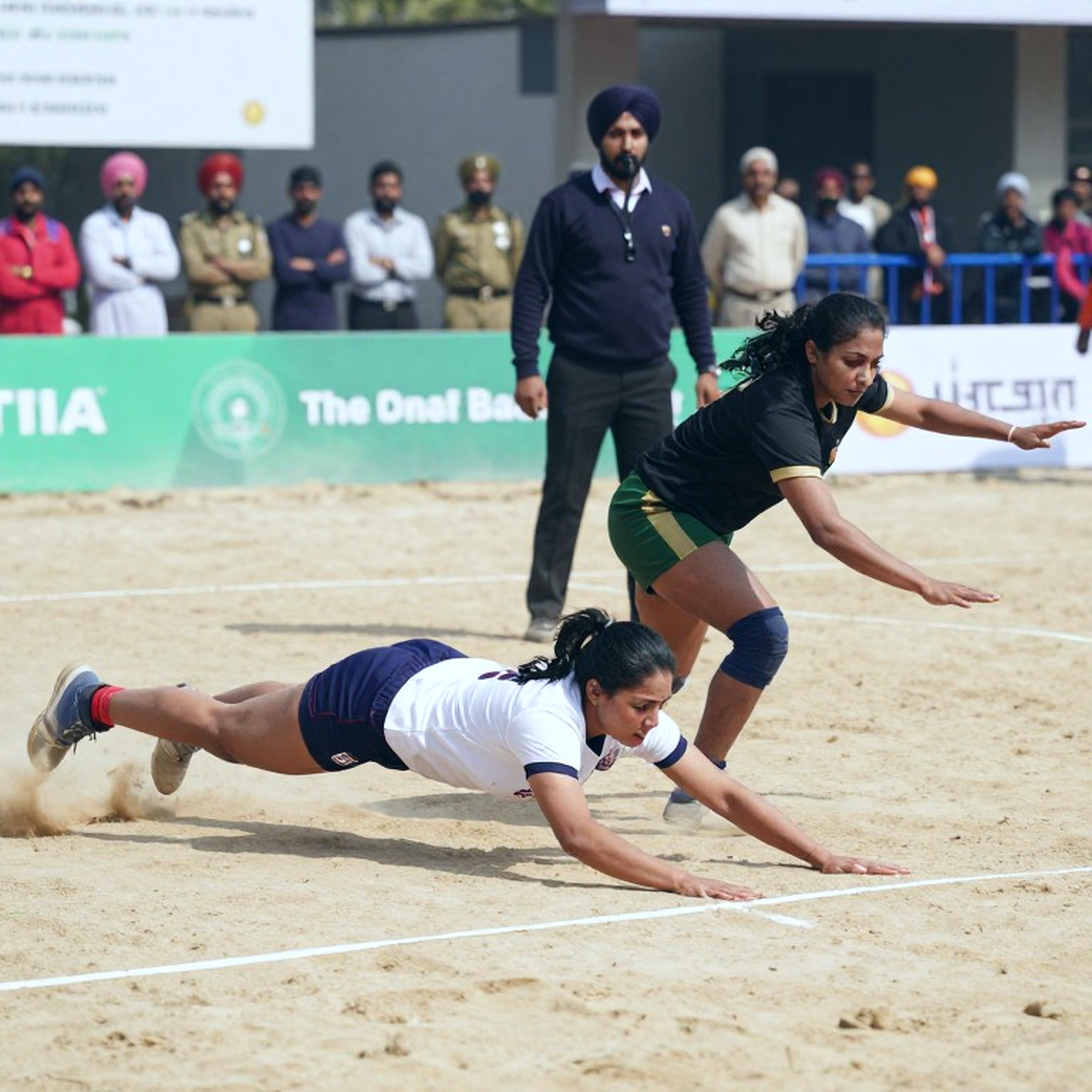
The structure of kabaddi is simple, and that simplicity is its strength. Two teams, seven players each on the court, squads of twelve. The men's court is 13 by 10 metres, the women's 12 by 8. One player at a time — the raider — enters the opposing half and must return within thirty seconds. That thirty-second limit is the sport's harshest rule: you do not have to stop breathing, but the moment the clock runs out the raid is dead. Touching a defender and returning scores one point; catching the raider scores one for the defence. And when every player on the opposing side has been put out, the raid earns a 'lona' — two points, and the entire opposing team returns to the mat. A lona can turn any match: in a few seconds the points gap flips and the psychological advantage changes hands.
Raiding has become a discipline of its own. Once the raider's main weapon was force — a shove, a straight collision. Now the technique is finer. In a toe touch, the toe or heel brushes a defender's foot and returns before the defender registers that a point has gone. In a hand touch, a finger grazes a shoulder or back. The dubki — dropping the whole body low and slipping under the defenders' waists — is the most risky and most watchable skill, because failure means landing in a web of four or five players. The bonus line has pushed aggression further: going deep inside the seven-metre zone to touch a defender earns an extra point, but returning from there is the hardest part. A modern raider therefore carries three or four options into every raid, and takes the point on the second or third feint rather than the first.
Defence has changed too. The solo tackle has given way to the chain tackle, where two or three defenders stop the raider's momentum together — one controls the hip, one grabs the ankle or calf, one applies pressure from above. Ankle holds and thigh holds are most effective because the raider's speed comes from the legs. In a block, defenders place themselves like a wall in the raider's path; in a dash, the whole unit moves forward and pushes the raider past the boundary. The hardest part of defence is patience: a rushed tackle often concedes a point and swings the match. Modern teams talk less about the points difference and more about tackle percentage, because the ability to repeatedly stop points is what wins games.
The biggest modern turning point was the arrival of the professional league. Launched in 2026, the Pro Kabaddi League put the sport into television prime time. The effect showed at three levels. First, visibility — cameras had never gone this close to a raider's feet; replays and graphics explained rules that had previously kept viewers away. Second, economics — auctions and contracts opened a path for players, so the sport no longer depended only on a government job or a railway team. Third, and most enduring, the pipeline — the league seeded academies, scouting and video analysis across states. The league also endured a long pandemic pause and returned, which showed its base was more than early novelty. But there is a warning: centralisation in a few cities and a few sponsors can leave the sport exposed, and the pay gap between the league and the domestic circuit is wide.
Internationally, kabaddi's identity was built through the Asian Games. Men's kabaddi became an official event at the 2026 Beijing Asian Games, and women's kabaddi joined the medal list from the 2026 Guangzhou Asian Games. For three decades India has been the sport's biggest axis, but the competition has not stayed one-sided. Iran built its team with unusual deliberation — physical strength, disciplined defence and the patience to keep one core group together. South Korea, Thailand, Bangladesh and Chinese Taipei have also made their place. This expansion brought an interesting shift: the laws and refereeing of kabaddi must now be refined with more than one country's interests in mind, because every nation wants to shape the game to its own physique and style.
Women's kabaddi is the fastest-growing part of the sport, and a story in itself. Where the men's game received decades of institutional support, women faced a struggle for basic infrastructure, coaches and match time. International medals nevertheless opened the door to domestic recognition — families, schools and state associations changed their stance. Today the problem is not talent but continuity: long gaps between seasons, thin broadcast coverage and limited rehabilitation after injury. For women players, scientific support on nutrition, injury management and training aligned with the menstrual cycle is still the exception rather than the rule.
The challenges ahead are clear and there is no reason to hide them. First, injury — kabaddi loads the knees, ankles and shoulders heavily, because the body twists in unpredictable directions during a tackle. Second, the calendar — domestic and international seasons often collide, forcing players to choose. Third, data — compared with cricket and football, kabaddi has few public, standardised statistics; metrics like tackle efficiency, raid success rate and lona dependence are still counted differently by every team. Fourth, coaching depth — being a player and being a coach are separate skills, and certified coaching curricula need to expand. Fifth, and most basic, access to mats — village games are still played on raw mud, while at competitive level the speed and grip of a mat demand an entirely different technique. A player who has not competed on a mat before the age of twelve is years behind in adjusting to international pace.
Kabaddi's strength is that it needs no construction — only opportunity. It does not depend on height, expensive equipment or a special ground; seven players, a boundary line and thirty seconds of courage are enough. That is why it is putting down roots beyond South Asia. But popularity and institutional strength are different things. The next decade will decide whether kabaddi remains a regional sport with one excellent professional league, or becomes a genuinely global one — which requires standardised statistics, safe training practices, mat availability at every level, and equal resources for the women's game. A sport that came out of the mud has now risen above it; the question is how deep its roots stay.
संबंधित खिलाड़ी
अनुशंसित
23 Teams, 62 Matches and One Empty Column: Kabaddi's First Commonwealth Championship Opens in Ahmedabad2026-10-26
The Third Raid: Do-or-Die Conversion and the Half-Second the Left Cover Loses2026-11-01
Ahmedabad Has 62 Matches and 13 Nations — but the Number That Matters Is 232026-10-24
The Empty Fourteenth Slot in Ahmedabad: Pakistan's Withdrawal and the Question the Scoresheet Never Asks2026-10-23
The Empty Page, The Full Lesson: When Kabaddi's Data Pipeline Returned Zero2026-10-24
Commonwealth Kabaddi Championship 2026: India's Win Ledger — The Hidden Truth Between Iran's Absence and 49-Point Margins2026-10-29
अनुशंसित
Surjeet Singh Named India Captain, Naveen Kumar His Deputy — But the Real Question Is the Squad List2026-10-23
The New Maths of Kabaddi: Victory Is Decided in the Triangle of Raiding, Defence and Data2026-11-02
Commonwealth Kabaddi Championship 2026: Sri Lanka and Scotland Top Day 1 Points Table, India Second2026-10-28
Surjeet Singh captain, Naveen Kumar deputy: India's real test in Ahmedabad is raiding depth, not captaincy2026-10-28
The Empty Fourteenth Slot in Ahmedabad: Pakistan's Withdrawal and the Question the Scoresheet Never Asks2026-10-23
Kabaddi: From the Mud Court to the Global Stage2026-11-02
अनुशंसित
The Score-Difference Arithmetic: Why Day 1 in Ahmedabad Makes Bangladesh Look Smaller Than It Is2026-10-30
Commonwealth Kabaddi Championship 2026: Six Matches in Seven Days — India's Real Test Is Rotation, Not England2026-10-29
Kabaddi's Empty Column: Where Raid Data Ends and Coaching Begins2026-10-26
The Empty Fourteenth Slot in Ahmedabad: Pakistan's Withdrawal and the Question the Scoresheet Never Asks2026-10-23
23 Teams, 62 Matches and One Empty Column: Kabaddi's First Commonwealth Championship Opens in Ahmedabad2026-10-26
Jakarta's Ledger and Iran's Co-Favourite Status: The New Arithmetic of Kabaddi2026-10-30
अनुशंसित
The Mud's Ledger: This Regular Season Is Being Decided by the Third Raider's Lungs, Not the Star's Name2026-11-01
The Captain Was Named Before the Squad List Arrived — What the Surjeet-Naveen Pairing Reveals Ahead of Ahmedabad2026-10-30
The Third Raid: Do-or-Die Conversion and the Half-Second the Left Cover Loses2026-11-01
The Silence After the Bid: Reading Kabaddi's Transfer Ledger, and the Purse Nobody Published2026-11-01
Kabaddi: From League to National Team — The Reinvention of a Sport and Its Unresolved Knots2026-11-01
Commonwealth Kabaddi Championship 2026: Sri Lanka and Scotland Top Day 1 Points Table, India Second2026-10-28