
होमKabaddiKabaddi: From Clay Courts to Broadcast Studios — The Rise of a Sport and Its Unresolved Challenges
Kabaddi: From Clay Courts to Broadcast Studios — The Rise of a Sport and Its Unresolved Challenges
कबड्डी एक संपर्क खेल है जिसमें सात-सात खिलाड़ियों की दो टीमें 30 सेकंड की बारी में रेडिंग और टैकलिंग के जरिए अंक बनाती हैं; रेडर को लगातार 'कबड्डी' कहते हुए विपक्षी कोर्ट में जाकर कम से कम एक डिफेंडर को छूकर लौटना होता है। यह 1990 बीजिंग से पुरुष और 2010 ग्वांगझू से महिला वर्ग में एशियाई खेलों का पदक खेल है। 2014 में शुरू हुई प्रो कबड्डी लीग ने खेल को टेलीविज़न उत्पाद बनाकर खिलाड़ियों की आय और दृश्यता बढ़ाई, पर घरेलू ढाँचा, खेल प्रशासन (AKFI), महिला वर्ग की दृश्यता और खिलाड़ी कल्याण अभी भी कमजोर कड़ियाँ हैं। अंतरराष्ट्रीय स्तर पर भारत और ईरान मुख्य प्रतिस्पर्धी हैं; 2018 जकार्ता एशियाई खेलों के पुरुष फाइनल में ईरान ने भारत को हराया था और 2023 हांगझोउ में भारत ने पुरुष तथा महिला दोनों वर्गों में स्वर्ण जीता।
Kabaddi today exists in two different worlds at once. In one, it is the game of Indian villages and small towns, where there is no measured mat of 13 by 10 metres, only a line drawn with lime and earth packed hard after rain, and where seven boys stand linked arm in arm. In the other, it is a professional league sport with high-definition cameras, slow-motion replays, action cams, data analysts, physios, nutritionists, commentary boxes and an entire economy built on clipped mobile videos. This duality is both kabaddi's greatest strength and its greatest problem. A strength because the sport's roots lie in culture — it needs no artificial tradition to manufacture an audience. A problem because when a sport runs on two different economic logics, the gap between its top and its bottom widens every year.
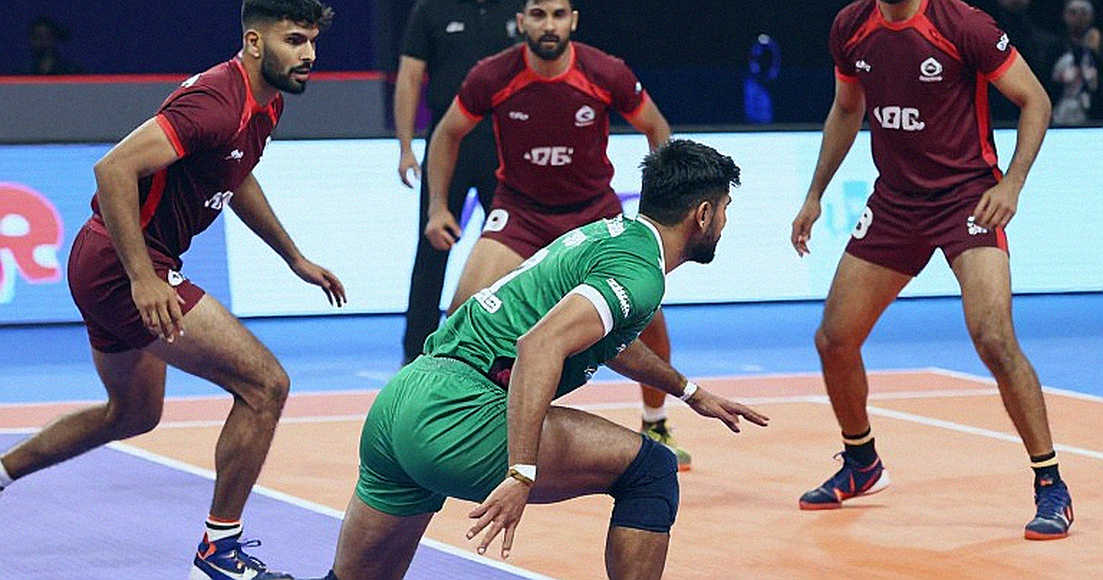
The rule system looks simple but its details make the sport fast and technical. A team fields seven players on the court and seven substitutes. On each turn, a raider must enter the opposing half within 30 seconds, touch at least one defender and return to his own half — and throughout the attempt he must chant 'kabaddi, kabaddi' continuously, which is both a test of breath and the source of the sport's name. A touch earns a point, crossing the bonus line earns more, and if all seven opponents are put out, the raider's team earns a two-point 'lona'. For the defensive side, points come through tackles — waist holds, thigh holds, ankle holds, or a sharp dash. This is why attack and defence are studied with equal seriousness in kabaddi, which separates it from cricket or football; here no player is merely a support act.
Internationally, kabaddi's identity was built through the Asian Games. Men's kabaddi became an official medal sport at the 2026 Beijing Asian Games, and for a long period one country's name stayed at the top of the medal table. Women's kabaddi took two more decades to find a place — it became a medal event at the 2026 Guangzhou Games. That delay still shows: the women's game does not have as old a competitive tradition as the men's, and its depth in the domestic structure is thinner. Bodies such as the International Kabaddi Federation (IKF) and the Asian Kabaddi Federation do not have the resources of a commercial league, and that gap creates constant tension between the sport's two systems.
The commercial turn came in 2026 with the launch of the Pro Kabaddi League. This was not merely a new competition but a deliberate attempt to convert the sport into a television product. Playing on a mat made camera coverage easy, the shape of the court created a studio-like frame inside the stadium, and a 40-minute match was an ideal duration for television. Rules were adjusted — the bonus point concept and categories such as super raid and super tackle — so that risk would be rewarded and the match would turn repeatedly. Over time the number of teams grew to twelve, city-based franchises emerged, the player auction became an event in itself, and the season was split into three phases. The whole exercise lifted kabaddi out of the bracket where it was seen as rural entertainment alone.
At the economic level the impact is clear. Before the league, a state-level kabaddi player's main income came from a government job under the sports quota or a local sponsor. After the league, a market of contracts, brand associations and training camps opened up for top players. This change is real and should not be understated — for many families it was the first time kabaddi could run a household. But the change is highly uneven. The distance between the few hundred players who find a place in the league and the thousands outside it is greater than ever. Players who go unpicked at auction have no route but to return to the same semi-professional structure they came from.
A second tension emerges from the same economic logic — the calendar. The league season, state competitions, the national championship and international camps all demand space in the same year. Top players play continuously in the league, which raises injury risk and shrinks the time available for national camps. This problem exists in almost every sport, but it becomes sharper in kabaddi because the core of national team preparation is exactly those players who play the most in the league. When the body itself is the main capital — in kabaddi, collision, falling and holding are the sport — then managing fatigue is not merely a performance issue but a safety issue.
The geography of international competition has also changed. For a long time kabaddi was seen as one country's game, but Iran broke that assumption systematically. The Iranian team's strength lies in physical build, a wrestling-like grappling tradition and a disciplined defensive strategy. At the 2026 Jakarta Asian Games men's final, Iran beat India to take gold — regarded as the most significant turning point in kabaddi history, because it proved that the podium is not a natural right. In competitions since, India has responded and regained the men's gold at the 2026 Hangzhou Asian Games; in the women's event India also reached the top. But Iran's rise is not the outcome of a single final; it is the presence of a permanent competitor that has put pressure on Indian selection and strategy.
Countries such as Bangladesh, South Korea, Thailand, Japan, Chinese Taipei and Kenya have also registered their presence. Some of these teams remain far from the top level, but their existence is essential to the international calendar — a sport with only three or four competitive nations can never be taken seriously on the Olympic agenda. That is why, for the IKF, spreading the game is not a matter of prestige but of survival.
Within India, the geography of talent matters just as much. Haryana, Uttar Pradesh, Maharashtra, Karnataka, Tamil Nadu and Delhi-NCR have been the main kabaddi centres. In these regions the game moves forward through a chain of village fairs, school competitions and local clubs, where coaches are often former players themselves and training rests on experience rather than scientific method. That difference is most visible at the door of the Pro Kabaddi League: of two players of the same age, the one picked is the one who reached a franchise trial, not necessarily the one who might have been technically better. This imbalance in scouting limits the depth of the sport.
Looking at the skills inside the game, kabaddi has developed its own vocabulary. In attack, the 'dubki' — slipping between a defender's legs, touching him and returning — is a skill that has captured the audience's imagination, and its most famous name has been Pardeep Narwal, known precisely for this skill. Raiders such as Naveen Kumar are identified by their ability to accumulate points consistently, Rohit Kumar for leadership and decision-making under pressure, and Ajay Thakur for experience and the ability to change a game on big occasions. In defence, names such as Fazel Atrachali and Manjeet Chhillar are examples of the fact that in kabaddi defence is not a passive role but an active strategy that decides the course of a match. These names have become references not only in fans' memory but in the sport's coaching curricula.
The state of women's kabaddi is the clearest mirror of this whole picture. Internationally the Indian women's team has performed strongly at the Asian Games repeatedly and won gold at the 2026 Hangzhou Games. Domestically, a women's league took time to stabilise, and its share of audience and broadcast remained smaller than the men's game. This gap is not only financial; it is a gap in visibility, which then translates into sponsorship, training facilities and career security. Until women's matches receive the same prime-time slots and the same production quality, the sport will only be half developed.
At the level of broadcast and data, kabaddi has learned from cricket. Action cams, cameras inside the court, slow-motion checks of tackles, raid success rate, tackle success rate, average points per raid — all of these are now part of match coverage. Short clips made for social media have carried the sport to audiences who do not watch a full match. One consequence is that the sport's success is now measured not only by spectators in the stadium but by time spent on screens. This shift was necessary, but it has also created a new dependency — the sport's attention has moved towards what looks good on camera.
At the administrative level, kabaddi's problems are old and serious. The Amateur Kabaddi Federation of India (AKFI) has faced crises from time to time over election disputes and governance complaints, and on such occasions the sports ministry has intervened and changed the administrative arrangements. Every such intervention affects players directly — selection processes are disturbed, competitions stall, and sponsors see uncertainty. For a sport flying on one commercial wing, this is the weakest link. Internationally too, relations between various bodies have not always been smooth, which keeps raising the question of who holds the sport's global representation and on what basis.
On player welfare, work remains. Doping control, rehabilitation after injury, and financial security after a career ends — kabaddi's systems lag behind mature ecosystems such as football or cricket on all three. Some support structures have become available for players who feature in the league, but for the thousands outside it the situation remains uncertain. Injury in kabaddi is not the exception, it is the rule; and when a player's entire income rests on his body, insurance and rehabilitation must be treated as basic infrastructure, not luxury.
The shortage of infrastructure and coaches should be seen through the same lens. There are limited mat-based training centres in the country with technical analysis, video review and fitness assessment. Most players are built on mud grounds and play on a mat for the first time when they reach state or national level — even though ankles, knees and shoulders are expected to turn as fast on the mat as the body is not used to. Expanding coach education programmes is therefore as necessary as new stadiums.
Looking ahead, three fronts are clearest. First, a stable international calendar — regular world-level competitions beyond the Asian Games, giving countries a basis for long-term planning. Second, entry into the Olympic agenda. With talk of India's ambition to host the 2036 Olympics, the question of whether kabaddi can find a place in the Olympic programme has become more relevant; but that will be decided not by hosting alone, but by expanding global participation, clear governance and a sustainable competition structure. Third, filling the domestic pyramid — bridging the gap between the league and the village game through school, college and district-level competitions.
The 2026 Asian Games will be the next test in this direction. In the men's event India will face the challenge of holding its dominance, Iran of recovering it, and the rest of Asia of proving they are not there merely to participate. In the women's event the contest is more open, because the base of experience is thinner and a well-prepared team can change the order.
Kabaddi's real story is that in two decades it achieved what many sports took centuries to achieve — a professional league, television audiences, global competition and identity. But its next leap will not come from the league growing larger. It will come from whether the sport can strengthen its lower tier as much as its upper tier — that is, whether a player from a village has a mat, a coach, treatment for injury and career security. Until that question is answered, a large part of kabaddi's success will shine on screen and remain incomplete on the ground.
संबंधित खिलाड़ी
अनुशंसित
Kabaddi: From League to National Team — The Reinvention of a Sport and Its Unresolved Knots2026-11-01
Surjeet Singh captain, Naveen Kumar deputy: India's real test in Ahmedabad is raiding depth, not captaincy2026-10-28
The Mud's Ledger: This Regular Season Is Being Decided by the Third Raider's Lungs, Not the Star's Name2026-11-01
The Captain Arrived Before the Squad: Three Gaps Inside India's Commonwealth Kabaddi Championship 2026 Announcement2026-10-23
Ahmedabad's 39 vs 23: The Number the Commonwealth Kabaddi Championship Poster Left Out2026-10-23
The Captain Was Named Before the Squad List Arrived — What the Surjeet-Naveen Pairing Reveals Ahead of Ahmedabad2026-10-30
अनुशंसित
Surjeet Singh captain, Naveen Kumar deputy: the real Commonwealth Kabaddi Championship 2026 story is the calendar and Iran's absence2026-10-23
The Empty Page, The Full Lesson: When Kabaddi's Data Pipeline Returned Zero2026-10-24
Kabaddi Analysis Report: How to Write the Game's Story When the Data Is Empty2026-11-01
The Captain Arrived Before the Squad: Three Gaps Inside India's Commonwealth Kabaddi Championship 2026 Announcement2026-10-23
The Empty Fourteenth Slot in Ahmedabad: Pakistan's Withdrawal and the Question the Scoresheet Never Asks2026-10-23
Kabaddi: From League to National Team — The Reinvention of a Sport and Its Unresolved Knots2026-11-01
अनुशंसित
23 Teams, 62 Matches and One Empty Column: Kabaddi's First Commonwealth Championship Opens in Ahmedabad2026-10-26
Thirteen Nations, Nine Days, One Empty Screen: The Commonwealth Kabaddi Championship 2026 in Ahmedabad2026-10-23
The Empty Page, The Full Lesson: When Kabaddi's Data Pipeline Returned Zero2026-10-24
Jakarta's Ledger and Iran's Co-Favourite Status: The New Arithmetic of Kabaddi2026-10-30
Surjeet Singh Named India Captain, Naveen Kumar His Deputy — But the Real Question Is the Squad List2026-10-23
Kabaddi Analysis Report: How to Write the Game's Story When the Data Is Empty2026-11-01
अनुशंसित
The Score-Difference Arithmetic: Why Day 1 in Ahmedabad Makes Bangladesh Look Smaller Than It Is2026-10-30
Four Wrong Memories of Kabaddi: From the 2026 Rupture to the 2026 Auction, the Corrected Frame2026-10-29
Kabaddi's Empty Column: Where Raid Data Ends and Coaching Begins2026-10-26
India's Opening Match in Ahmedabad: Read the Availability Ledger Before the England Scoreboard2026-10-29
India vs England: In Ahmedabad, the Squad Audit Is Bigger Than the Result2026-10-29
Kabaddi: From League to National Team — The Reinvention of a Sport and Its Unresolved Knots2026-11-01